You are currently viewing documentation for CompuTec ProcessForce 3.0, which is a plugin installed and managed through CompuTec AppEngine 3.0, built on .NET 8. If you are working with older environments, you may need the documentation for CompuTec ProcessForce 2.0: https://learn.computec.one/docs/processforce/2.0/.
Please note that CompuTec ProcessForce 2.0 will be supported only until December 31, 2026. After this date, the product will no longer receive regular support or maintenance updates. Read more
CompuTec AppEngine 3.0 introduces a new architecture, and all CompuTec components, including the CompuTec ProcessForce 3.0 plugin, must be updated together to ensure full compatibility.
Before starting your installation or upgrade process, we strongly recommend reviewing the CompuTec AppEngine 3.0 and CompuTec ProcessForce 3.0 documentation.
Bill of Materials form Header
The Bill of Materials (BOM) Header form enables users to define the structure of a Bill of Material for a final product or a component used in another Bill of Material. This feature ensures precise material management and production planning.
To access Bill of Materials form Header, navigate to:
Production → Bill Of Materials → Bill of Materials → Header
Key Features
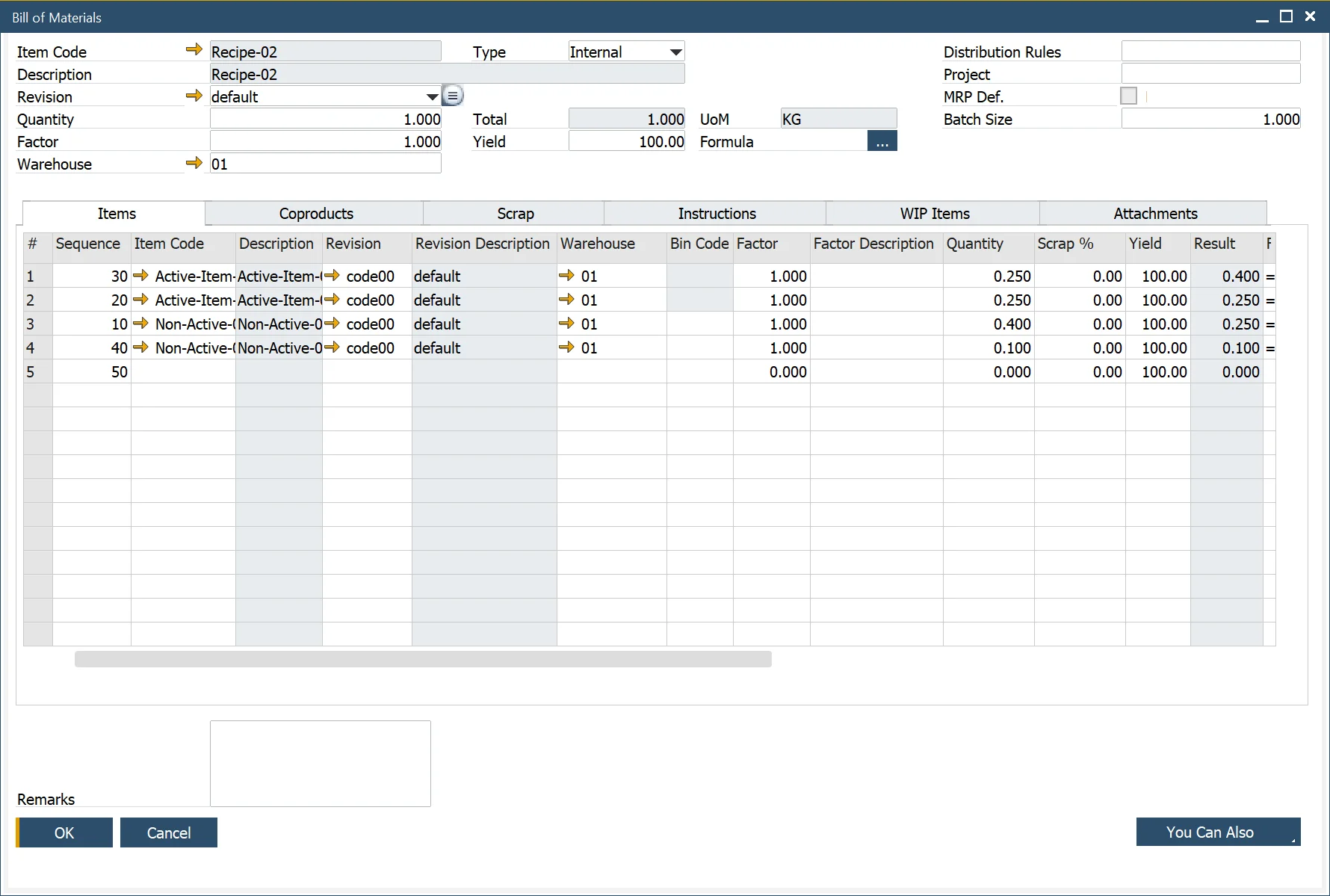
- Multiple BOM Versions: users can create multiple BOMs for a product based on the Revision Code, managed in Inventory → Item Details → Revision Tab. Learn more Click here to find out more.
- Quantity & UoM: specifies the required product quantity and unit of measure (UoM) for the parent item. The Quantity and UoM represent the product quantity of the parent item.
- Factor: defines variables affecting parent and component quantities, such as yield or scrap.
- Warehouse: identifies the production location.
- Type Field: indicates whether the product is Internal (produced in-house) or External (subcontracted).
- Distribution Rule & Project: optional fields for tracking financial and operational data.
- MRP Default: determines if this BOM is the default for Material Requirements Planning (MRP). If unchecked, the BOM does not sync with SAP Business One.
- Batch Size: defines production batch sizes to calculate costs, considering setup time, fixed runtime, stock, and queue time.